1739 Documents found
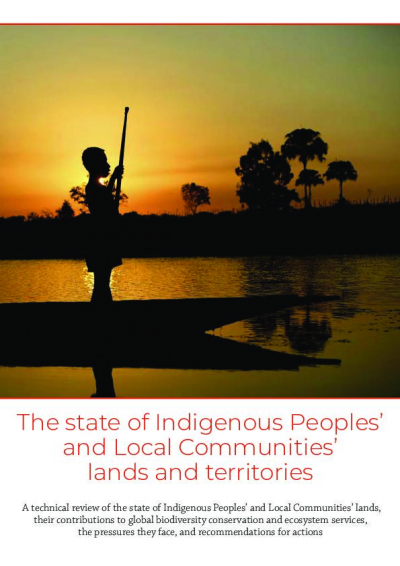
Quotes from Indigenous leaders from different countries on the State of Indigenous Peoples’ and Local Communities’ Lands and Territories report.

The State of Indigenous Peoples and Local communities lands and Territories report is a result of extensive collaboration between the United Nations Environment Programme World Conservation Monitoring Centre (UNEP-WCMC), the World Wildlife Fund, and over 10 other collaborating organizations, partners, and networks. Its key findings include that 91 per cent of Indigenous Peoples and local communities’ lands are in “good and fair ecological condition”, and that these lands contain at least 36 per cent of the global surface covered by Key Biodiversity Areas. At present, these lands cover at...
SGP COUNTRY PROGRAMME STRATEGY FOR
OPERATIONAL PHASE-7
(2020 - 2023)
BHUTAN
This is an illustrated summary of the Third Joint GEF-UNDP Evaluation of the Small Grants Programme (SGP), which is the result of a collaborative effort between the Independent Evaluation Offices of the Global Environment Facility (GEF) and the United Nations Development Programme (UNDP). This evaluation covered the period between July 2014 and December 2019, with the objective of building on the findings of and evaluating progress made since the second joint evaluation. It also aimed to report on the relevance, effectiveness, efficiency, and sustainability of the SGP at both global and local...
This report is the result of a collaborative effort between the Independent Evaluation Offices of the Global Environment Facility (GEF) and the United Nations Development Programme (UNDP). It is the third joint evaluation of the GEF Small Grants Programme (SGP), which is implemented by UNDP. The evaluation covered the period between July 2014 and December 2019, with the objective of building on the findings of and evaluating progress made since the second joint evaluation. It also aimed to report on the relevance, effectiveness, efficiency, and sustainability of the SGP at both global and lo...
With the objective to serve as a corporate level document, GEF Small Grants Programme (SGP) M&E strategy is an effort to develop a common understanding of the Programme’s results and its pathways. It defines cardinal principles, measurements, and taxonomies to guide results management across the three levels of performance- project, country and global. SGP shares it with a spirit of transparency, and with an intent to provide deeper insights into the Programme’s approaches and practices that lead to environmental and socio- economic gains.
The Cambodia SGP OP7 Country Programme Strategy (CPS) is the primary document guiding the development, implementation, and monitoring and evaluation of the Cambodia GEF SGP activities during the Seventh Operational Phase (i.e. 2020 - 2023). The Cambodia GEF CPS, which builds on more than 15 years of Cambodia GEF SGP work and experience in the country, specifically identifies the goal, strategic objectives and outcomes that Cambodia GEF SGP proposes to achieve over GEF Operational Phase 7. The CPS also sets the basic project eligibility criteria. To achieve the objectives, the CPS includes OP...

Fact sheets for schoolchildren developed within the project "The use of environmentally friendly alternative technologies on the territory of the Kostyukovichi district (installation of solar-powered street lamps) as a way to reduce carbon dioxide emissions"
BLR/SGP/OP7/Y1/CORE/CC/20/02
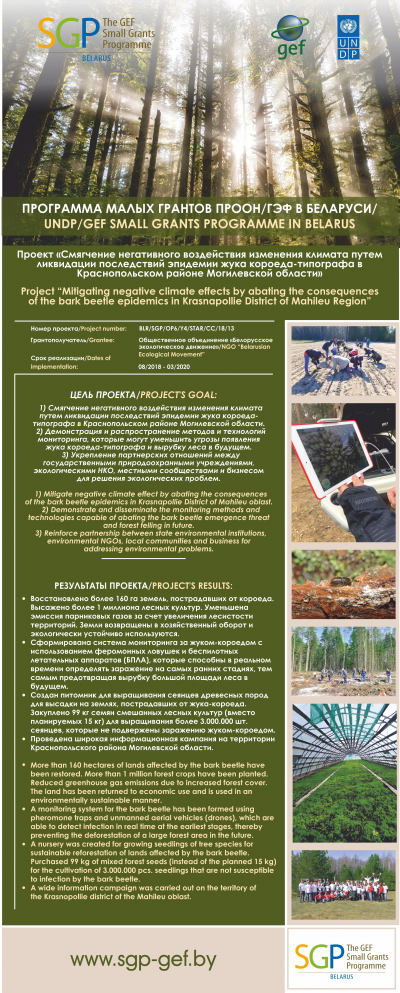
Projects results for SGP Belarus in 2020.
Page 44 of 194