


1570 Documents found
Sustainable Land Management is quickly becoming one of the largest portfolio of the SGP. Together with partners, the SGP supports community organizations to use approaches, techniques and methodologies in line with the principles of agroecology and climate-sensitive land resources management. In this publication, you will find good practices and approaches that has been tested and proven successful by SGP projects around the world. These initiatives have shown evidence on improved land management by communities, nested on traditional knowledge and innovation.

This booklet highlights COMDEKS contributions to achieving the Aichi Biodiversity Targets, as well as the critical role that local communities play in ecosystem protection and biodiversity conservation.The publication contains two parts:Part 1 introduces COMDEKS and its community-based landscape approach for conserving ecosystems and biodiversity and promoting sustainable livelihoods. It outlines the rationale for why community action is vital to conserving biodiversity in rural landscapes outside of Protected Areas.Part 2 portrays how COMDEKS has contributed to achieving all five of the Strat...
This guide provides conceptual and methodological elements for developing and promoting agroecological innovations within country strategies to address agroecosystem resilience in specific production landscapes. It is intended to serve as the basis for the implementation of the Innovative Agroecology component of the GEF Small Grants Programme in its 6th Operational phase, and to provide guidance for the agroecosystem outcome of the COMDEKS landscape approach.The guidance note explains basic agroecological concepts, principles and its application in the design and management of biodiverse and ...
This publication highlights SGP’s three decades of experience in engaging civil society and local communities, including Indigenous Peoples, women, youth, and persons with disabilities, on locally-led climate action, adaptation and resilience. The projects presented demonstrate how financial mechanisms with a community and locally-led action window allow vulnerable communities easy and direct access to international funding and can help effectively address some of the loss and damage linked to climate change.

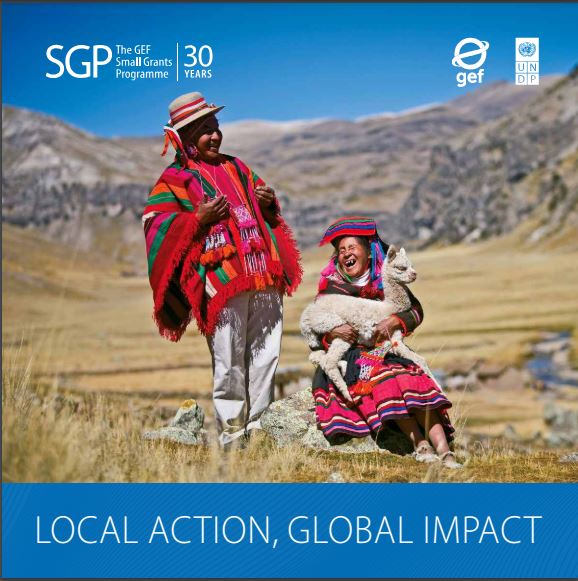
This is a commemorative publication to celebrate SGP’s 30 years of local action, global impact. The publication highlights the important role of local communities, civil society and Indigenous Peoples, youth, women and persons with disabilities in addressing global environmental issues – such as biodiversity loss, climate change mitigation and adaptation, land degradation, international waters, and chemicals and waste management – while improving well-being and livelihoods. Throughout its journey, SGP has continuously evolved and has now grown into a unique global delivery mechanism to s...
SGP supports community-based approaches to reduce, eliminate and prevent the use of mercury, and promote the safe handling of mercury-containing products. Since 2011, SGP has supported 40 community-based projects to reduce and manage mercury with an investment of $1.2 million, leveraging $1.26 million in co-financing.

In 2009 the GEF Small Grants Programme (SGP) entered into a partnership Australian Aid to improve the climate resilience of local communities in 42 countries, including 37 SIDS. The goals of the programme are to: reduce the vulnerability and improve the adaptive capacity of local communities to the adverse impacts of climate change; provide countries with concrete ground level experience on local climate change adaptation; and provide clear policy lessons and mainstream community-based adaptation (CBA) within national processes, and scale up best practices. This brochure provides a summary of ...

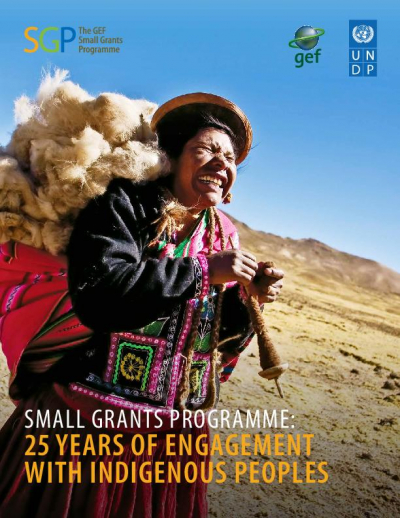
This publication provides an account of SGP’s experience working with Indigenous Peoples over the last twenty-five years. The publication celebrates past achievements and advances critical lessons that can be used in forging new partnerships with Indigenous Peoples in future programming cycles, including opportunities to employ blended finance solutions. Building on the learning-by-doing experience gained over six Operational Phases, combining resources from the GEF with those of other bilateral donors, the SGP has cumulatively delivered financial support to over 25,000 community-based proje...
As a pilot initiative, this publication presents the work of the Global Support Initiative to ICCAs (ICCA-GSI) from 2014 (pilot phase) to 2022 (with Phase 2, rapid response to the COVID-19 pandemic). The ICCA-GSI is a multi-partnership initiative that is implemented by UNDP, through the Small Grants Progamme and funded by the Government of Germany, through its Federal Ministry for the Environment, Nature Conservation, Nuclear Safety and Consumer Protection (Bundesministerium für Umwelt, Naturschutz, nukleare Sicherheit und Verbraucherschutz, or BMUV). Key partners include the Secretariat of t...

Page 155 of 157