


1570 Documents found
El Programa de Pequeñas Donaciones (PPD), dentro de la Sexta Fase Operativa (OP6) 2016 - 2020 en alianza con la Comisión Asesora sobre la Degradación de la Tierra – CADETI, se planteó el objetivo de brindar apoyo en la conservación y protección de los recursos naturales para el mejoramiento de las condiciones de vida de las personas. Para ello, impulsó una serie de proyectos que abordaron el manejo del recurso hídrico en la cuenca de los ríos Jesús María y Barranca, beneficiando a comunidades en la gestión de ASADAS, protección de nacientes, mejoramiento en infraestructura y a...
La meliponicultura (crianza de las abejas sin aguijón Apidae-Meliponini) es una actividad milenaria desarrollada en Costa Rica desde tiempos precolombinos. Se lleva a cabo en las áreas rurales del país de manera tradicional para la producción de miel que es utilizada con fines medicinales o comercializada para aportar a la economía familiar. Debemos protegerlas con el fin de garantizar los servicios de polinización que brindan y que a su vez influyen sobre nuestra seguridad alimentaria, además, su manejo posee muchas ventajas. En Costa Rica, se conocen alrededor de 50 especies de abejas...
El país se ha propuesto la meta de contribuir con el proceso global de responder a la perdida de la biodiversidad, la degradación ambiental y la crisis climática y demuestra que crecer de la mano del medio ambiente no es imposible. Los grandes desafíos del desarrollo sostenible requieren de soluciones creativas, audaces e inclusivas que se aborden de manera integral. Para lograr las metas plasmadas en la Agenda 2030, donde la erradicación de la pobreza es prioritaria, las tres dimensiones del desarrollo - ambiental, social y económica - deben tratarse de forma conjunta, sin que un aspect...
Desde el 2016, el Programa de Pequeñas Donaciones, implementado por el PNUD, en alianza con la Comisión Asesora sobre Degradación de Tierras – CADETI, el Ministerio de Agricultura y Ganadería – MAG y el Ministerio el Ambiente – MINAE, y con financiamiento del Fondo para el Medioambiente Mundial (FMAM), ha venido promoviendo el desarrollo sostenible con enfoque de paisaje dentro de dos cuencas prioritarias: Río Jesús María (CRJM) y del Río Barranca (CRB)”, en la región Pacifico Central de Costa Rica, a través de iniciativas que coadyuven a la recuperación de las condiciones d...
This publication contains a systematization of the contribution by the Small Grants Programme (SGP), in Costa Rica, for the 1992-2015 period; documenting the technical and financial support provided to an emerging sector that has grown in importance over the last 20 years, namely, Rural Community Tourism (RCT). Rural Community Tourism first appeared in Costa Rica as a development alternative to the poverty in which rural areas are often subjected. It has become a determining factor for the rural economy. “Rural tourism represents a form of nonagricultural rural employment. This type of emplo...
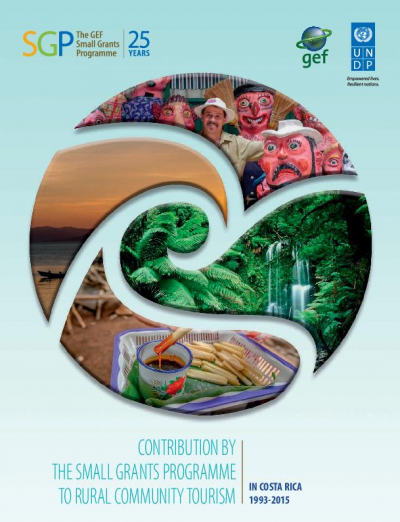
Esta publicación contiene la sistematización del aporte realizado por el Programa de Pequeñas Donaciones (PPD) Costa Rica en el periodo 1992-2015, en el proceso de acompañamiento técnico y financiero a un sector que emerge, y tiene su crecimiento cúspide durante los últimos 20 años; se trata del Turismo Rural Comunitario. El Turismo Rural surgió en nuestro país como una alternativa de desarrollo a las condiciones de pobreza en que se encuentran inmersas las zonas rurales y el mismo se ha convertido en un factor determinante de la economía rural; “El turismo rural representa una fo...

Publication '10 Years of People Empowerment Success' is dedicated to the 10th anniversary of the GEF SGP in Ukraine. For over 10 years now, SGP in Ukraine has been supporting community-based projects and empowering people to contribute to the achievement of global environmental goals. Every initiative has its own heroes with their life-changing stories, and this book reveals only a tiny portion of them.
This is the Executive Summary of the Annual Monitoring Report .

The Brochure provides, in summary form, the SGP Lesotho interventions and achievements during the Sixth Operational Phase (OP 6). For OP 6, the SGP focused its interventions in the Senqu/Orange River Basin as the selected priority landscape. The Landscape which covers more than 60% of the country, is by and large a mountainous region, producing ecosystem services that sustain the economy of the country and to some extent, the southern Africa region.

The process for the development of the COMPACT Site Strategy for Sehlabathebe National Park was funded by UNESCO through the Netherlands Funds-in-Trust (NFiT) Cooperation with co-financing from UNDP - Lesotho, GEF Small Grants Programme Country Programme in Lesotho in partnership with the Ministry of Tourism, Environment and Culture and Sehlabathebe National Park (SNP). A parallel process took place in South Africa for the uKhahlamba Drakensberg park, the South African component of the Maloti Drakensberg Park World Heritage Site (MDP WHS), thereby necessitating cross-fertilization between the ...

Page 56 of 157